

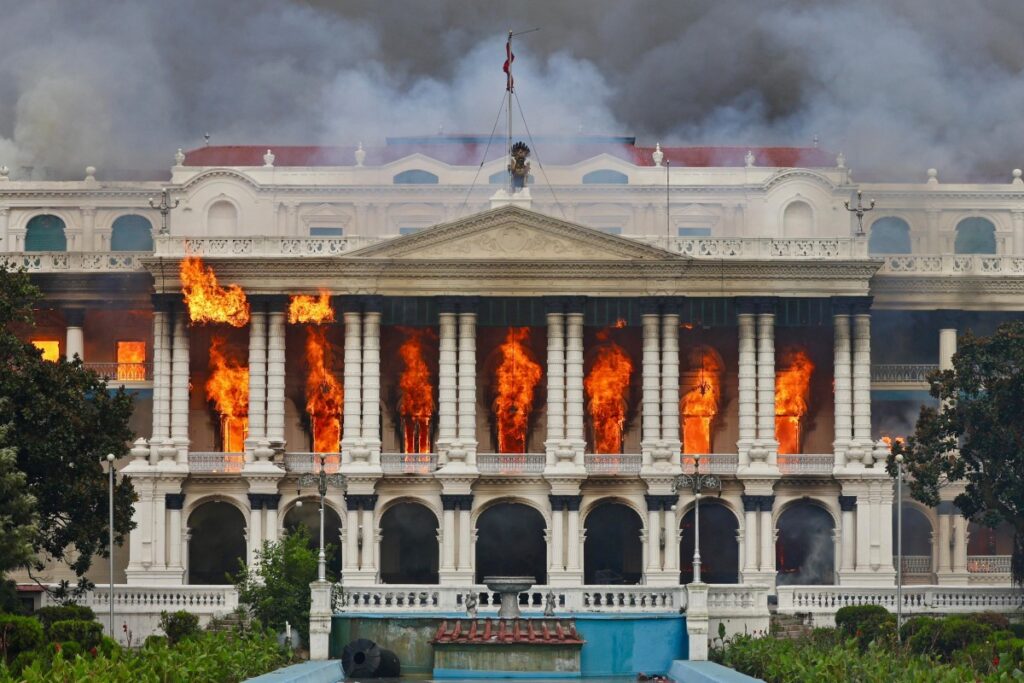
Fire rages through the Singha Durbar, the main administrative building for the Nepal government, in Kathmandu on September 9, 2025, a day after a police crackdown on demonstrations over social media prohibitions and corruption by the government. Nepali youth protesters set fire to parliament on September 9 as the veteran prime minister obeyed furious crowds to quit, a day after one of the deadliest crackdowns in years in which at least 19 people were killed. (Photo by Prabin RANABHAT / AFP) / The erroneous mention[s] appearing in the metadata of this photo by Anup OJHA has been modified in AFP systems in the following manner: [Byline - Prabin RANABHAT] instead of [Byline - Anup OJHA]. Please immediately remove the erroneous mention[s] from all your online services and delete it (them) from your servers. If you have been authorized by AFP to distribute it (them) to third parties, please ensure that the same actions are carried out by them. Failure to promptly comply with these instructions will entail liability on your part for any continued or post notification usage. Therefore we thank you very much for all your attention and prompt action. We are sorry for the inconvenience this notification may cause and remain at your disposal for any further information you may require.
Supporters of President Bola Tinubu are pushing back against fresh calls for mass protests in Nigeria, amid comparisons to a youth-led revolt in Nepal that forced the resignation of its prime minister and unleashed the country’s deadliest unrest in years.
In Nepal, frustration over politicians’ lavish lifestyles fueled a Generation Z-driven movement. Angered by a bloody crackdown, demonstrators defied curfews, torched key government buildings including the Supreme Court and parliament, and ultimately toppled the prime minister.
Inspired by events in Kathmandu, Nigerian activists on social media urged citizens to rise against entrenched elites. Juwon Sanyaolu of the Take-it-Back Movement drew parallels to past global waves of youth activism, noting how Nigeria’s #EndSARS protests in 2020 were influenced by Black Lives Matter. Others on X suggested that if protests were to happen, they should target the nation’s seat of power, Aso Rock.
However, government loyalists have warned that any attempt to mimic Nepal’s revolt could spiral into violence worse than #EndSARS. Former presidential aide Reno Omokri rejected comparisons, insisting Nepal’s turmoil only brought regret. He urged security agencies to guard against provocateurs and popularized the hashtag #StartFromYourStateofOrigin, a call echoed by pro-government influencers and youth groups.
Prominent figures also joined the debate. Comedian Seyi Law criticised those celebrating Nepal’s unrest, warning that revolutions often lead to destruction and regret. Civil society voices, however, highlighted Nigeria’s worsening economic crisis. Enefa Georgewill of the Rivers Civil Society Organisations argued that leaders must “take a clue from Nepal” and address public frustration.
Debo Adeniran of the Committee for the Defence of Human Rights noted differences between Nepal and Nigeria’s struggles but admitted economic hardship in both countries could fuel anger. He also pointed to federal youth-focused programmes as a possible buffer against revolt.
Religious leaders voiced caution too. Reverend Yomi Kasali warned that Nigeria was not immune to upheaval if poverty and discontent deepened, stressing that even the innocent could suffer in such chaos.
The debate reflects Nigeria’s fragile balance between growing public frustration and government efforts to stave off unrest, with Nepal’s experience serving as both inspiration and warning.


